
The hallway smelled like wet boots and fresh paint.
Mina balanced a cardboard box on her hip, nudged Unit 2B’s door with her elbow, and listened to the building settle into evening. Radiator clicks. A distant dog bark. Her phone buzzed again.
“Hey Mina, I sent rent,” her tenant texted. “Did you get it?”
Mina stared at her banking app. Nothing.
She’d been a landlord long enough to know the scary part wasn’t the missing money. It was the fog. No receipt. No consistent timing. No clean answer when someone asks, “Where’s the proof?”
And in 2026, with more tenants expecting tap-to-pay convenience, Mina needed to pick the right system, not just the familiar one. She needed better rent payment methods in Canada.
The month Mina realized her rent payment methods in Canada were the problem
It started small. Annoyingly small.
A tenant paid by Interac e-Transfer, but used a nickname Mina didn’t recognize. Another paid from a joint account, so the sender name didn’t match the lease. A third tenant asked if they could put rent on a credit card “just for this month.”
Mina’s kitchen table became a command center.
Receipts printed. Screenshots saved. Notes scribbled on a sticky pad that kept sticking to her sleeve (rude).
Then the real tension hit.
Her mortgage payment was automatic. Her rent collection was not.
“Can we switch to something consistent?” she asked her friend Jonah, another small landlord, over a crackly phone call.
Jonah didn’t hesitate. “Consistent is great. But you also need proof. Future-you will thank you.”
Mina had three pain points, and they were all quietly expensive.
Late or hard-to-confirm payments.
Payment records scattered across apps and email.
Awkward tenant conversations when a method “works” but creates disputes.
That’s when she opened RentMouse and decided to rebuild the workflow instead of patching it.
She started where the pain lived: how rent moved from tenant to landlord.
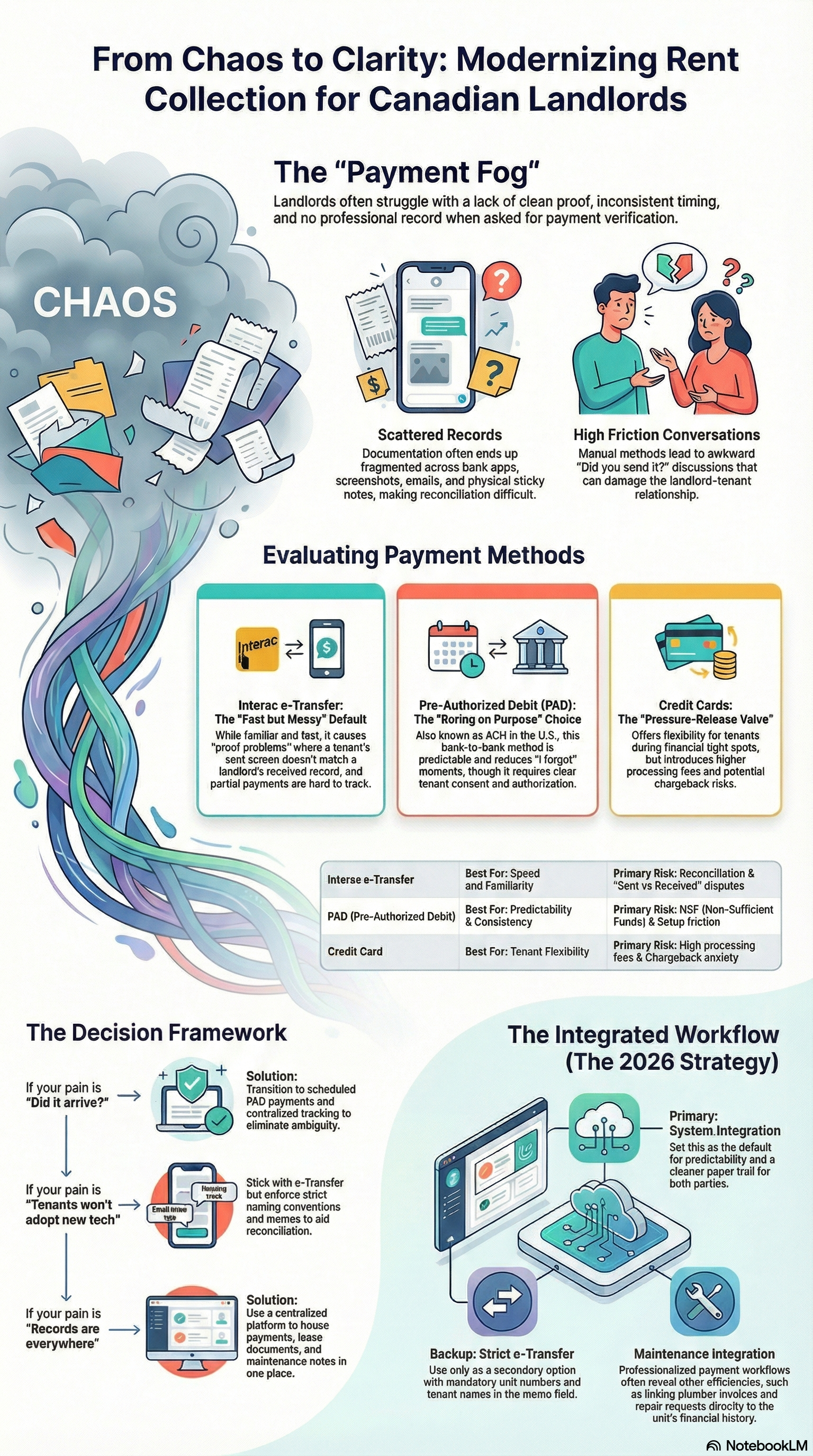
Option 1: Interac e-Transfer for rent (fast, familiar, but messy)
Interac e-Transfer is the default in a lot of Canadian rentals because it’s easy to explain.
“Just send it to my email.”
Done.
But Mina learned the tradeoff the hard way.
What e-Transfer does well
Speed: money can arrive quickly.
Tenant adoption: most people already know how.
Low friction: no new portal logins needed.
Where e-Transfer can go sideways
Proof problems: a tenant’s “Sent” screen doesn’t always equal “Received.”
Reconciliation: matching sender names to units can get weird.
Partial payments: you end up tracking “$800 now, $600 Friday” in text threads.
Mina’s tenant, Chris, was polite but stressed.
“I swear I sent it,” he said on the phone.
“I believe you,” Mina replied, rubbing her forehead. “I just need a clean record on my side too.” (Because anxiety loves paperwork.)
So she set a new rule: no more hunting through email chains to confirm rent.
She switched to a centralized workflow using RentMouse’s rent collection tools, so each payment was tied to the tenant and the unit, with a consistent ledger she could actually trust.
Option 2: PAD in Canada (and ACH in the U.S.): the “boring on purpose” choice
If Mina could pick one word for pre-authorized debit, it would be: steady.
In Canada, landlords often call it PAD (Pre-Authorized Debit). In the U.S., you’ll hear ACH (Automated Clearing House). Different rails, similar goal: bank-to-bank payments that run on a schedule.
Why PAD can be a landlord’s best friend
Predictability: scheduled payments reduce “I forgot” moments.
Cleaner records: fewer manual confirmations.
Lower dispute risk: less ambiguity than “I sent it.”
What to watch for
Setup friction: tenants may hesitate if they’ve had bad experiences with withdrawals.
NSF risk: you still need a plan for failed payments.
Consent and documentation: you want clear authorization stored safely.
Mina’s fear wasn’t the technology. It was the conversation.
“Are you going to pull money whenever you want?” a tenant asked, half-joking.
“No,” Mina said. “It’s the opposite. It’s scheduled and documented. You’ll see it coming.”
She updated her lease language and payment expectations so it didn’t feel like a surprise policy change. She kept the signed authorization and related paperwork organized using lease management and document storage in RentMouse, so she wasn’t digging through downloads at midnight.
Now the agreement wasn’t just verbal. It was provable.
Option 3: Credit card rent payments (flexible, but usually costly)
Credit cards can feel like a pressure-release valve.
A tenant’s hours got cut. Their car needed repairs. They want to smooth the month.
Mina understood that. She also understood math.
Credit card processing typically comes with fees, and those fees have to land somewhere. Sometimes the tenant pays a convenience fee. Sometimes the landlord absorbs it. Either way, it changes the economics.
When credit card rent can make sense
As an exception, not the default.
For tenants who value rewards or short-term float.
When you want to offer flexibility but keep rules clear.
Risks to plan for
Higher costs.
Chargeback anxiety (rare in rent contexts, but the worry alone can age you).
Tenants carrying balances at high interest.
Mina didn’t want to be the “no” landlord. She wanted to be the “clear” landlord.
So she created a simple policy: credit card is allowed only in defined situations, with fees disclosed upfront, and with receipts stored alongside the lease and payment history.
And she tracked any payment-related costs and bank fees as they happened, not at tax time, using expense tracking. The difference was immediate. Her books stopped feeling like a junk drawer.
A quick decision framework: which rent payment method fits your rental?
Mina wrote this on a notepad, then taped it inside a cabinet door.
Choose based on what you actually need
If your biggest pain is “Did it arrive?”
Lean toward PAD/ACH schedules and centralized tracking.
If your biggest pain is “Tenants won’t adopt anything new”
Start with e-Transfer, but add rules for naming, memos, and timing.
If your biggest pain is “Tenants need flexibility sometimes”
Allow credit cards as a backup method with clear fees and receipts.
And then she added the part she’d been ignoring:
If your biggest pain is “My records are everywhere”
Centralize payments, documents, and maintenance notes in one place.
Because payment disputes rarely stay isolated.
They spill into everything.
The surprise connection: payment chaos triggers maintenance chaos
Two weeks after Mina tightened her payment workflow, her phone buzzed at 7:03 a.m.
A video. A kitchen sink. A slow, stubborn leak.
“Not an emergency,” the tenant wrote. “But it’s getting worse.”
Old Mina would’ve handled it in texts, then lost the plumber invoice, then forgotten whether she’d reimbursed the tenant for a temporary fix.
This time, she routed it through RentMouse maintenance tracking so the request, updates, and costs stayed tied to the unit.
It smelled like coffee and lemon cleaner in her kitchen as she watched the timeline populate.
For the first time in a while, she felt ahead.
(Also, she didn’t have to scroll through 47 messages to find the plumber’s number. Small miracles.)
Near the finish line: the tenant conversation that didn’t turn into a fight
The next rent day arrived.
Mina checked her dashboard. Payments were logged. One tenant’s payment failed, and she saw it quickly, with a clear status.
She called the tenant, Dani.
“Hey Dani. Quick heads-up, the payment didn’t go through. Want to retry today or set a split?”
Dani exhaled audibly. “Thank you for not making it weird. I can retry after lunch.”
“Perfect,” Mina said. “Message me if you want a different date going forward.”
No accusation. No confusion. Just a plan.
That was the real win.
Not just money collected.
Trust preserved.
The setup Mina kept: a simple 2026 workflow for rent payment methods in Canada
Mina’s final system wasn’t complicated. It was consistent.
Primary method: scheduled PAD-style bank payments for predictability.
Backup method: e-Transfer with strict naming conventions and memos.
Emergency option: credit card only when pre-approved with fees disclosed.
One place for records: payments, authorizations, receipts, and unit notes.
RentMouse showed up in the story the way Mina needed it to: quietly, in the background, making the boring parts actually boring.
And when she reviewed everything at month-end, she realized she hadn’t said “Where is that screenshot?” even once.
She closed her laptop.
The building was quiet.
Her shoulders dropped.
That’s what better rent payment methods in Canada feel like.
CTA
If you want rent to be predictable, provable, and easy to track, set up your rent workflow in RentMouse. Start by checking plans and choosing what fits your doors: /pricing.
Sources
Rent payment rules, fees, and recordkeeping expectations can vary by bank and region. These references support the broader trends and systems discussed:
[1] Interac Corp. Interac e-Transfer overview. https://www.interac.ca/en/consumers/products/interac-e-transfer/ (accessed 2026-02-22)
[2] Payments Canada. About automated clearing and settlement systems in Canada (including EFT concepts). https://www.payments.ca/ (accessed 2026-02-22)
[3] Government of Canada. Keeping records for your taxes (recordkeeping guidance for individuals and businesses). https://www.canada.ca/en/revenue-agency/services/tax/businesses/small-businesses-self-employed-income/keeping-records.html (accessed 2026-02-22)
[4] Consumer Financial Protection Bureau (U.S.). Electronic Fund Transfers (Regulation E) overview. https://www.consumerfinance.gov/rules-policy/regulations/1005/ (accessed 2026-02-22)
Test Your Knowledge! 🎯
Question 1 of 5


