
You’re about to build a Quebec lease process that’s boring, provable, and easy to repeat. You’ll walk away with a step-by-step workflow for quebec landlord lease laws that helps you avoid the classic problems: missing forms, fuzzy promises, and “I never got that” disputes.
A quick scene. It’s 9:41 p.m. in Montréal. The radiator clicks. The hallway smells faintly like wet wool and takeout. You’re staring at a lease draft and a text from a prospective tenant: “Can we just do something simple?”
Simple is good. But in Quebec, “simple” still needs the right paperwork.
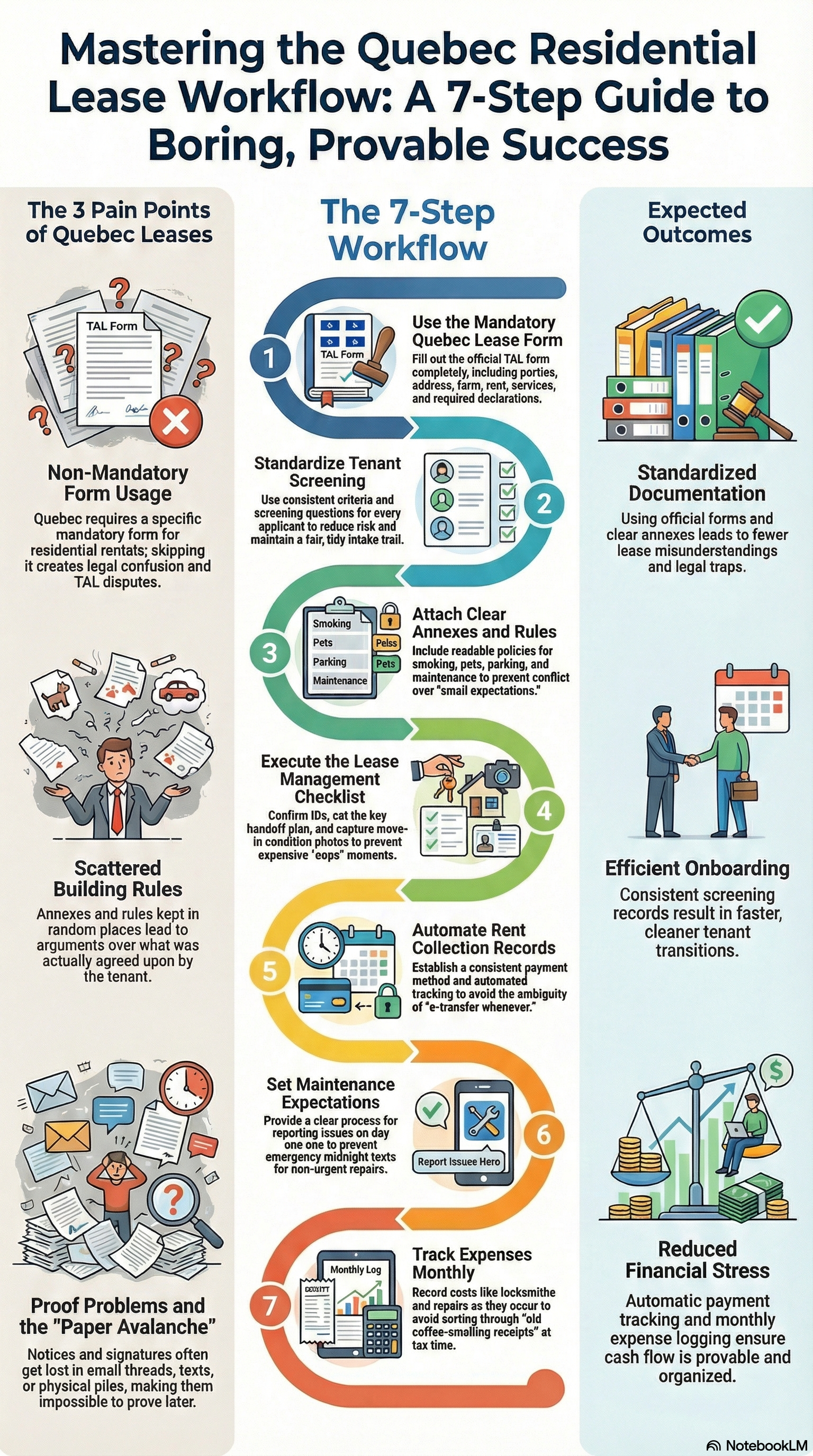
The 3 pain points that make Quebec leases blow up
Using the wrong lease format or missing required info. Quebec has a mandatory lease form for residential rentals. Skip it, and you invite confusion later.
Annexes and building rules living in random places. If the rules aren’t delivered clearly, you’re left arguing about what was agreed to.
Proof problems. Notices, signatures, and key documents disappear into inboxes, texts, and printer piles (the classic paper avalanche).
RentMouse helps by keeping your lease, documents, rent payments, and communication organized in one place, so your process doesn’t rely on memory and screenshots.
Step 1: Confirm you’re using the mandatory Quebec lease form (and why it matters)
What to do: Start with the official Québec residential lease form and fill it out carefully: parties, address, term, rent, services included, and any required declarations.
Why it matters: Under quebec landlord lease laws, the lease isn’t just “a contract you found online.” Quebec requires a mandatory form for residential leases, and the official structure helps prevent missing disclosures that later turn into disputes at the Tribunal administratif du logement (TAL) [1].
Warning: Don’t treat a generic North American lease template as “close enough.” Quebec is different. Civil law. Specific forms. Different expectations.
Step 2: Build a clean tenant intake and screening trail (without chaos)
What to do: Collect applications and screening info consistently, then decide using the same criteria for every applicant.
Why it matters: Screening is where landlords accidentally create risk. Inconsistent questions, missing consent, and scattered notes can come back to haunt you. A tidy workflow is calmer and fairer.
If screening is one of your stress points, connect it to a single system using RentMouse’s tenant screening tools so you’re not juggling email threads and half-filled PDFs.
Pro tip: Write down your screening criteria before you post the unit. You’ll make faster decisions, and you’ll sound more confident on calls (even if you’re sweating a little).
Step 3: Attach the right annexes and rules, then deliver them the same way every time
What to do: Add annexes for anything that will matter later: building rules, smoking policy, pet policy, parking, storage, appliances list, move-in condition notes, and any special clauses that are allowed.
Why it matters: Most landlord-tenant conflict isn’t about “big law.” It’s about small expectations. Noise. Keys. Laundry hours. Who shovels what. When the rules are clear and delivered up front, the building runs quieter.
This is where RentMouse earns its keep: store your lease and annexes together so you can prove what was provided and when. Link your workflow to document storage.
Callout: Tip Keep annexes short and readable. Big walls of text don’t get read. They get ignored.
Step 4: Put the lease on rails with a repeatable lease management checklist
What to do: Create a mini checklist for every new tenancy:
Mandatory lease form completed
Annexes attached
IDs and contact info confirmed
Move-in date and key handoff plan set
Rent payment method set
Condition notes and photos captured
Why it matters: The checklist prevents “oops.” And “oops” is expensive. Especially when you’re busy, traveling, or managing more than one door.
Centralize the lease lifecycle in RentMouse so the lease doesn’t live as a lonely PDF on your laptop. Start here: lease management.
(Yes, it feels a bit type-A. That’s the point.)
Step 5: Make rent payment boring on purpose (and keep proof automatically)
What to do: Decide how rent will be paid, when it’s due, and what happens if it’s late. Then set it up so payments and records are tracked automatically.
Why it matters: Late rent isn’t just a cash flow problem. It’s a documentation problem. If you ever need to show a timeline, you want clean records without digging through bank apps and text messages.
RentMouse can help you set up a consistent collection workflow through rent collection. That’s the difference between “I think they paid” and “Here’s the ledger.”
Warning: Avoid side deals like “Just e-transfer me whenever.” It sounds flexible. It creates ambiguity. Ambiguity creates arguments.
Step 6: Set expectations for maintenance requests on day one (so your phone stops buzzing at midnight)
What to do: Tell tenants exactly how to report issues, what counts as an emergency, and what info you need (photos, description, access times).
Why it matters: Under Quebec’s rules, landlords have maintenance obligations, and tenants have duties too. But in real life, the fight starts when the process is unclear. If the tenant doesn’t know where to report a problem, they’ll text you at 11:58 p.m. with a blurry photo and the words “urgent.”
Connect this pain point directly to a system: RentMouse’s maintenance tracking keeps requests, updates, and timelines together.
Pro tip: Put a one-paragraph “How to request repairs” note in your annex. Tenants actually read short instructions (long ones? not so much).
Step 7: Track lease-related costs as you go, not at tax time
What to do: Record lease setup expenses and early tenancy costs: locksmith, paint, cleaning, appliance repairs, smoke alarm replacements, and any contractor invoices.
Why it matters: Landlords lose money in two ways: overspending, and under-documenting. When you track expenses month-by-month, you can see if a unit is quietly bleeding cash. Plus, you’re not stuck sorting receipts that smell like old coffee and winter coat pockets.
Tie the financial side to a single place using RentMouse’s expense tracking.
(Your future self will be weirdly grateful.)
Where this leaves you with Quebec landlord lease laws
If you follow the workflow above, quebec landlord lease laws stop feeling like a trap door. You’ll have the mandatory form handled, annexes delivered consistently, rent records that don’t rely on memory, and a maintenance channel that keeps small issues from turning into loud ones.
Expected outcomes
Fewer lease misunderstandings because the form and annexes are standardized
Faster, cleaner tenant onboarding with consistent screening records
Less late-rent stress because payment tracking is automatic and provable
Maintenance requests that feel organized instead of chaotic
A document trail you can actually find when you need it
CTA: Ready to make your next Quebec lease setup boring in the best way? Start using RentMouse for free and build your repeatable workflow today.
Sources
Quebec landlord lease laws vary by situation, and local rules can add requirements. This guide is general information, not legal advice.
[1] Gouvernement du Québec, Tribunal administratif du logement (TAL) information and forms, including the mandatory residential lease form. https://www.tal.gouv.qc.ca/
[2] Gouvernement du Québec, Educaloi, “Housing: Leases” and practical explanations of rights and obligations in Quebec. https://educaloi.qc.ca/en/categories/housing/
[3] Canada Mortgage and Housing Corporation (CMHC), Rental Market Reports and rental market data (Canada). https://www.cmhc-schl.gc.ca/professionals/housing-markets-data-and-research/housing-data/rental-market-report
[4] U.S. Bureau of Labor Statistics (BLS), CPI Shelter data for inflation context impacting rents and operating costs (U.S.). https://www.bls.gov/cpi/
Test Your Knowledge! 🎯
Question 1 of 5


