
The rain started like a whisper.
By 11:47 p.m., it was a drumline on the roof.
Jenna stood barefoot in her kitchen, the tile cold under her feet, listening to her phone buzz across the counter. The screen lit up the room in that harsh, bluish glow that makes every late-night message feel worse.
“Hey. There’s water coming through the ceiling in the hallway. It’s… dripping.”
Her rental was in Raleigh. She lived two states away. And she could already feel the familiar spiral: North Carolina landlord regulations. Repairs. Notices. Deposits. The stuff you only remember when something goes wrong.
(Also, why do leaks always show up after midnight?)
When North Carolina landlord regulations stop being “reading material”
Jenna had one of those small-landlord setups that looks calm on paper. Two single-family rentals. A day job. A spreadsheet that used to feel “good enough.”
But tonight wasn’t about spreadsheets.
Tonight was about proof.
Because the first pain point hit fast.
Pain point #1: Maintenance chaos that turns into a “who said what?” fight
Jenna tapped the tenant’s message and called. The line connected with a crackle.
“Is it actively dripping?” she asked.
“Yeah,” the tenant said, breathy and tense. “And the paint is bubbling. I put a bucket down.”
Jenna pictured it: dim hallway, wet drywall smell, that metallic scent rain brings in when it finds a way inside.
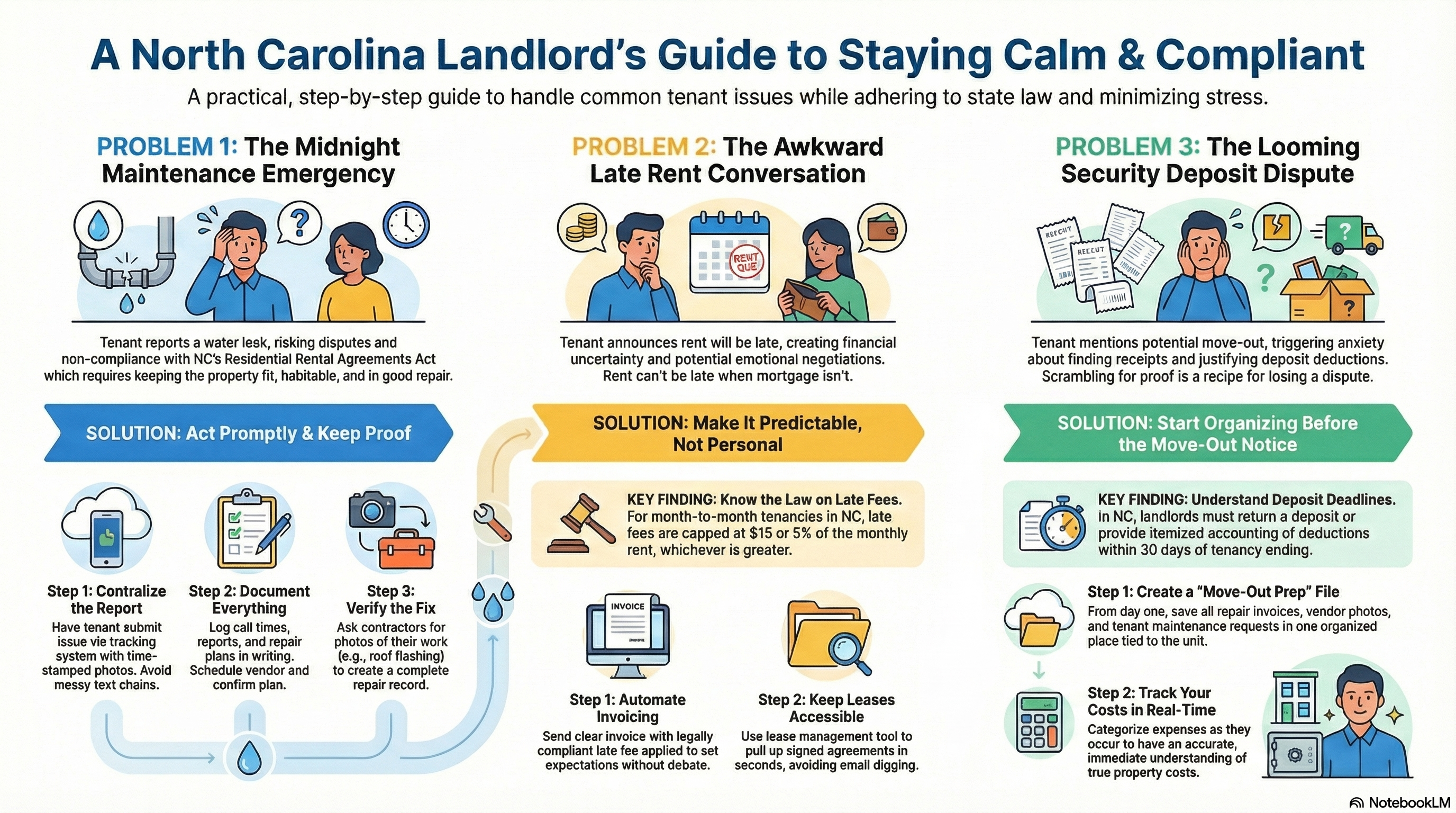
North Carolina’s landlord-tenant rules don’t hand you a magic timeline for every repair, but the state does require landlords to keep the property fit and habitable, including plumbing and keeping the roof and structure in decent repair under the Residential Rental Agreements Act.[1]
So the goal was simple.
Move fast. Document everything.
Instead of juggling texts, voicemails, and screenshots, Jenna opened RentMouse and sent the tenant a link to submit the issue through maintenance tracking.
The tenant uploaded photos. Time-stamped. Clear.
Jenna added notes: the call time, what the tenant reported, and the plan for a roofer in the morning.
Her contractor answered at 7:03 a.m. with a sleepy, gravelly voice.
“I can be there by ten,” he said.
“Please,” Jenna replied. “And take photos of the flashing when you’re up there.”
She didn’t say it out loud, but she was thinking it: if this gets disputed later, the record matters.
(Records are boring until they’re not.)
Pain point #2: Late rent, late fees, and the awkward message you don’t want to send
At 8:15 a.m., while she was still riding the adrenaline of the leak, a second notification popped up.
Different tenant. Different property.
“Hey Jenna, rent will be a few days late. Work cut my hours.”
Her stomach tightened. Not because she didn’t care. Because her mortgage didn’t care.
North Carolina allows late fees in many residential leases, but they’re capped by statute for certain tenancy types. For month-to-month tenancies, the late fee generally can’t exceed $15 or 5% of the monthly rent, whichever is greater.[2]
Jenna had a lease clause. She just didn’t want to argue about it over text.
So she did something that felt almost unfairly calm.
She used RentMouse to send an invoice and automated reminders through rent collection, with the late fee rules set to match what the lease allowed and what the statute permits.
The tenant replied two minutes later.
“Got it. I see the amount and the due date. I’ll pay Friday.”
No debate. No back-and-forth.
Just a plan.
And because Jenna didn’t want “Friday” to turn into “next Friday,” she pulled up the lease terms in seconds using lease management.
There it was. Clean language. Signed version. No digging through email threads titled “Lease FINAL final (2).pdf.”
The moment the security deposit starts haunting you early
By Wednesday, the leak was patched. The ceiling was drying. The tenant’s hallway smelled faintly of damp wood and fresh primer.
Jenna should’ve felt relief.
Instead, she felt the third pain point creeping in.
The tenant with the late rent mentioned they might move when the lease ended.
That’s when security deposit anxiety arrives. Early. Quiet. Persistent.
North Carolina security deposit rules include deadlines and handling requirements. Landlords generally must return the deposit within 30 days after the tenancy ends, or provide an interim accounting within 30 days and a final accounting within 60 days if they can’t determine the full amount right away.[3]
Jenna had been burned once before by a move-out dispute where she couldn’t find receipts fast enough.
Not again.
She started a “Move-out prep” folder in RentMouse and uploaded the contractor’s leak photos, the repair invoice, and the tenant’s original maintenance submission into document storage.
Everything stayed tied to the unit.
Not her desktop.
Not her inbox.
Not a shoebox.
(Yes, she used to have a shoebox. Don’t judge.)
North Carolina landlord regulations, but in the real world
Jenna didn’t need a 40-page legal treatise.
She needed a practical checklist that matched how problems actually show up.
Here’s what she focused on during the week from hell.
1) Repairs: act promptly and keep proof
North Carolina’s habitability requirements are real, and tenants can push back if essential repairs aren’t handled.[1]
Jenna’s takeaway: even when you can’t fix it instantly, you can show you responded instantly.
Log the report with photos.
Confirm the plan in writing.
Track vendor scheduling and completion.
That trail is what turns “you ignored me” into “here’s the timeline.”
2) Rent and late fees: make it predictable, not personal
Late rent turns emotional fast.
But the law and the lease are the law and the lease. North Carolina’s late fee limits are specific, and the safest move is to follow the statute and your written agreement.[2]
Jenna’s takeaway: remove the drama.
Send a clear invoice.
Apply late fees consistently.
Keep the payment ledger clean.
3) Deposits: start organizing before the move-out notice
North Carolina’s deposit return timelines can squeeze you if you’re scrambling for receipts.[3]
Jenna’s takeaway: build the file while the story is happening.
Save invoices and photos as you go.
Store inspection notes.
Keep communications in one place.
The quiet fix nobody talks about: money clarity
Friday came.
The late rent tenant paid at 9:12 a.m. Jenna heard the familiar ping from her phone while she was in line for coffee, the scent of espresso and warm pastry hanging in the air.
Paid.
She exhaled.
Then she did one more thing that used to take her an entire Sunday.
She categorized the roof repair and drywall patch costs inside expense tracking so she could see, in plain numbers, what that “small leak” actually cost.
Not later.
Now.
Because if you’re managing rentals in two countries or even two states, the fastest way to lose control is to wait until tax time to learn the truth.
The conversation that could’ve gone sideways (but didn’t)
A week later, Jenna’s Raleigh tenant messaged again.
“Hey, thanks for getting that fixed. The hallway’s dry now. But can you confirm the ceiling won’t mold?”
Jenna didn’t feel defensive. She didn’t feel cornered.
She felt prepared.
“Totally fair question,” she replied. “We repaired the roof entry point and replaced the wet drywall. I’ve got photos and the invoice from the contractor. If you see any staining come back, submit it right away and we’ll respond same day.”
The tenant answered:
“Appreciate it. I’ll keep an eye on it.”
No threat. No escalation.
Just trust, built out of receipts and timestamps.
North Carolina landlord regulations near the finish line: make your next emergency smaller
Jenna didn’t become a different person that week.
She still hated midnight leaks.
She still worried when rent was late.
But she stopped losing hours to chaos.
That’s the point of a system.
If you’re trying to stay compliant with North Carolina landlord regulations, the best time to get organized is before the next text hits your phone. The second-best time is right now.
RentMouse showed up in Jenna’s story as a quiet helper: one place for rent, leases, maintenance, documents, and expenses. Not more work. Less guessing.
CTA
Start your own calm workflow today: try RentMouse and set up rent collection, maintenance tracking, and lease records in one place.
Sources
[1] North Carolina General Statutes, Chapter 42, Article 5 (Residential Rental Agreements Act) https://www.ncleg.gov/EnactedLegislation/Statutes/HTML/ByArticle/Chapter_42/Article_5.html
[2] North Carolina General Statutes § 42-46 (Late fees and other charges) https://www.ncleg.gov/EnactedLegislation/Statutes/HTML/BySection/Chapter_42/GS_42-46.html
[3] North Carolina General Statutes § 42-52 (Landlord’s obligations, return of security deposit) https://www.ncleg.gov/EnactedLegislation/Statutes/HTML/BySection/Chapter_42/GS_42-52.html
[4] U.S. Department of Housing and Urban Development (HUD), Office of Lead Hazard Control and Healthy Homes: Lead-based paint resources https://www.hud.gov/program_offices/healthy_homes/enforcement/lshr
Test Your Knowledge! 🎯
Question 1 of 5


