
Maya was folding laundry at her kitchen table when her phone lit up.
A single photo. A beige ceiling. A dark, spreading bruise of water.
Then the text:
“Hey. The ceiling’s leaking again. It’s dripping onto the bed.”
Her stomach tightened.
She owned one small rental in Huntsville and two more doors across state lines. Nothing fancy. Just enough that a surprise repair could swallow a weekend and a chunk of savings.
And tonight, it wasn’t just the leak.
It was the fear underneath it. The kind that whispers: What does Alabama landlord law say I’m supposed to do right now? (Also: why do leaks always wait for after-hours?)
Alabama landlord law starts feeling real when something breaks
The air in Maya’s kitchen smelled like warm detergent and the lemon cleaner she’d used earlier. She stared at the photo again, thumb hovering over the keyboard.
She wanted to respond fast. She also wanted to respond correctly.
Because in Alabama, most rentals are governed by the Alabama Uniform Residential Landlord and Tenant Act (URLTA) for covered counties, and it sets expectations around habitability and the back-and-forth notices that happen when something goes wrong.[1]
Maya typed, deleted, typed again.
“Are you safe? Can you move your stuff away from the drip?” she finally sent.
A reply came back instantly.
Tenant: “Yeah. But it’s getting worse.”
Maya exhaled through her nose. That sharp, annoyed exhale.
She’d dealt with maintenance before. The real problem was what always came with it:
No clean timeline of what was reported and when.
No single place for photos, invoices, and the lease.
A creeping worry that she’d miss a notice requirement or document something wrong.
That’s how landlord headaches turn into landlord disputes.
So she opened RentMouse and did the thing she wished she’d always done from day one.
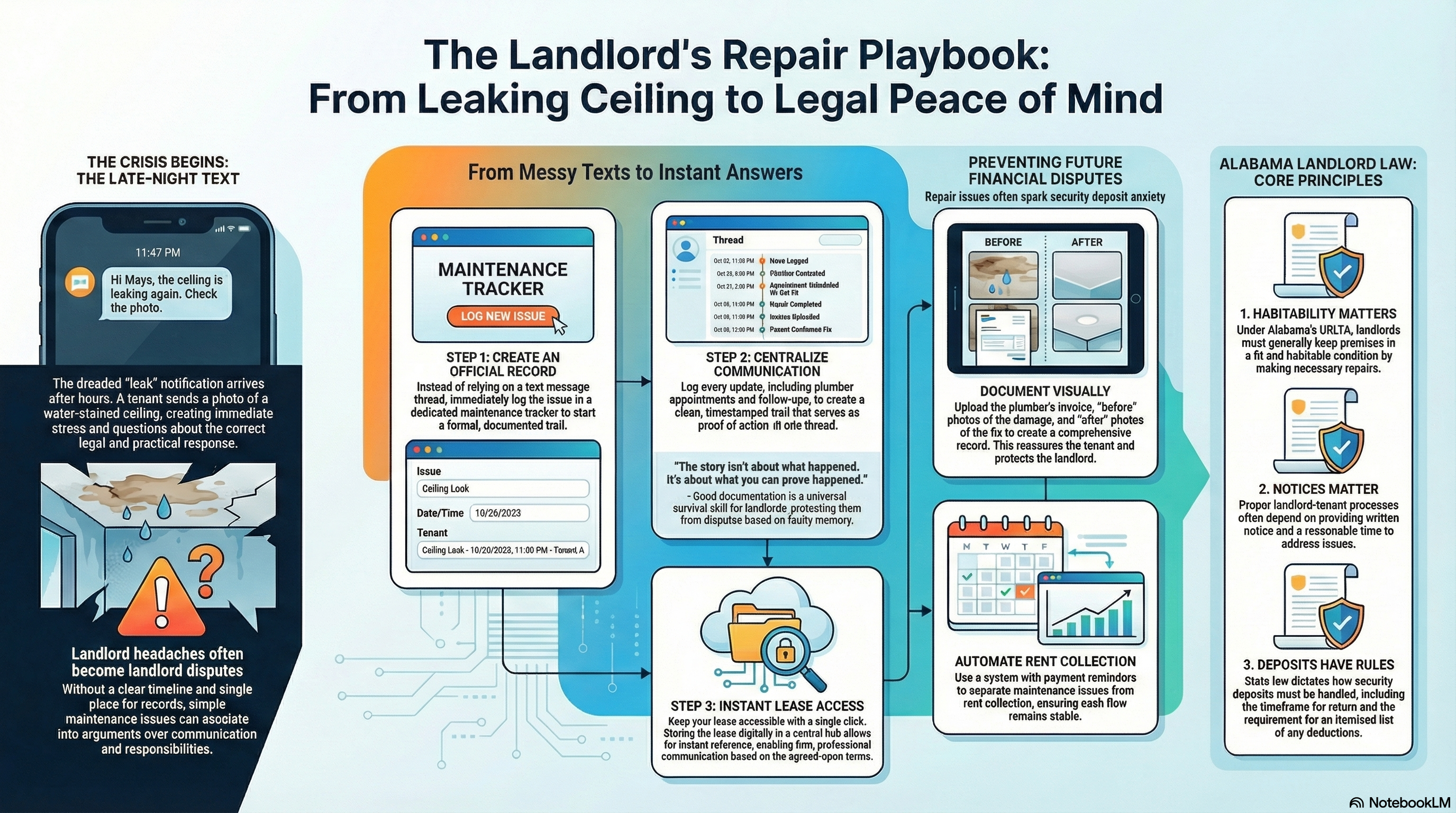
She created a maintenance request, attached the photo, and started a trackable thread right away using the maintenance tracking tools.
Now the leak wasn’t just a text message floating in the void. It was a record.
Pain point #1: Maintenance texts that turn into “you never replied”
By the time Maya’s plumber answered, it was already dark outside. The house felt too quiet, like it was waiting for the next bad notification.
“Can you get there tomorrow morning?” she asked.
“Earliest slot is 9,” he said.
Maya looked at the tenant’s photo again. Water stains don’t stay polite.
She messaged the tenant through the maintenance thread.
Maya: “Plumber booked for 9 a.m. Please keep the area clear. I’ll update you after the visit.”
It was simple. It was also strategic.
In landlord-tenant conflicts, the story usually isn’t about what happened. It’s about what you can prove happened.
RentMouse kept the conversation, timestamps, and attachments together, so if the tenant later said, “You ignored me for a week,” Maya had a clean trail. (Because memory gets weird when people are stressed.)
And yes, Alabama landlord law is not a one-size-fits-all checklist. But good documentation is a universal survival skill.
Pain point #2: Lease language and notice rules you can’t find when you need them
The next morning, the plumber found a failing seal in an upstairs bathroom.
“It’s slow,” he said, “which is why it’s been sneaky.”
Sneaky. Great.
Maya paid the invoice, then opened her laptop to answer the question that always pops up next:
Who’s responsible for what, according to the lease?
She remembered adding a clause about tenant reporting and not letting moisture issues sit. But where was that PDF? Email? Drive? Printer tray? The mysterious “Rental Stuff” folder?
She didn’t want to dig.
She wanted to click.
So she pulled up her lease inside RentMouse and reviewed it through lease management. The clause was there. Clear. Dated. Signed.
That one minute saved her from sending a sloppy message like, “I think the lease says…”
Instead she wrote:
“Thanks for reporting this. Per the lease, please keep reporting any moisture or leaks right away so we can prevent damage.”
Firm. Calm. Professional.
This is where Alabama landlord law and real life collide: the law sets the framework, but your lease and your records determine how cleanly you operate inside it.
Pain point #3: Security deposit anxiety that shows up early
Two days later, the tenant sent another message.
Tenant: “The ceiling stain is ugly. Are you going to repaint? Also, I don’t want to get blamed for this at move-out.”
Maya felt her shoulders rise.
Because that’s how deposit disputes start. Not at move-out. Right here, in the middle of a stressful repair.
Alabama’s security deposit rules include limits and requirements around returning the deposit and providing an itemized statement for deductions, with timelines that landlords need to follow.[2]
Maya didn’t want to promise anything she couldn’t deliver. She also didn’t want a future argument about “pre-existing damage.”
So she did two things:
She scheduled the repaint.
She documented the condition and repair trail.
She uploaded the plumber invoice, the before photo, and the post-repair notes into a single place using document storage.
Then she replied:
Maya: “You won’t be blamed for a plumbing failure. I’ve documented the repair and we’ll repaint after the area dries.”
The tenant’s response was short.
Tenant: “Thank you. That helps.”
And Maya realized something.
Most tenants aren’t looking for a fight. They’re looking for certainty.
The boring money part: rent should not be the second emergency
While the ceiling dried, Maya checked her bank app and felt that familiar pinch.
Rent was due in three days.
The repair invoice had already landed. If rent came late too, her “small landlord” budget would start doing that wobbly thing. You know the one.
So she made rent as boring as possible.
She confirmed the tenant’s payment settings and reminders through RentMouse, using the rent collection feature.
No awkward chasing.
No “Did you see my text?”
Just a clear system that logs payments and reduces the chance that a maintenance issue turns into a rent standoff.
Because even when everyone means well, life gets messy. Systems keep it clean.
Alabama landlord law and repairs: what to know at a practical level
Maya spent her lunch break reading, not doom-scrolling. Actual reading.
Here’s what she wrote on a sticky note and slapped to her monitor:
Habitability matters. Landlords generally must keep the premises in a fit and habitable condition, including making necessary repairs, under Alabama’s URLTA framework where it applies.[1]
Notices matter. Many landlord-tenant processes hinge on written notice and reasonable time to cure, especially when disputes escalate.[1]
Deposits have rules. Alabama law sets requirements for handling and returning security deposits and providing an itemized list of deductions within the required timeframe.[2]
This wasn’t about becoming a lawyer overnight.
It was about running a calmer business.
(And yes, she still had laundry on the table. Some things never change.)
The moment it almost went sideways
A week later, the tenant sent one more message.
Tenant: “My cousin says I should withhold rent until the stain is gone.”
Maya’s heart thumped once. Hard.
This is the fork in the road where relationships break.
She didn’t lecture. She didn’t panic.
She pulled up the maintenance log, the scheduled paint date, and the repair completion notes. All in one thread.
Then she replied:
Maya: “I understand the frustration. The leak is repaired and paint is scheduled for Friday. Rent is still due per the lease. I’ll keep you updated in the maintenance request thread so everything stays documented.”
Two minutes later:
Tenant: “Okay. Friday works.”
Crisis defused.
Not because Maya had the perfect words.
Because she had the receipts.
Why RentMouse fit this moment (without making it a bigger project)
Maya didn’t need enterprise software. She needed a steady hand.
RentMouse gave her:
A single, timestamped maintenance trail with photos and updates via /features/maintenance
A clean lease she could reference instantly via /features/lease-management
A place to store invoices and condition documentation via /features/document-storage
A way to keep cash flow predictable via /features/rent-collection
And it did something quieter too.
It made her feel less alone in the work.
Because the hardest part of landlording isn’t always the repair.
It’s the uncertainty.
Alabama landlord law, near the finish line: make your next problem smaller
On Friday, the painter showed up with a radio playing low classic rock. The unit smelled like fresh primer and that dusty-sweet scent of drywall.
The stain disappeared under a clean coat of white.
The tenant sent a final photo.
Tenant: “Looks good now.”
Maya leaned back in her chair and let the tension drain out of her neck.
She opened RentMouse one more time and closed the maintenance request with final notes and the completed invoice attached.
Then she made herself a promise: the next time Alabama landlord law gets relevant in a hurry, she won’t be searching through old emails at midnight.
She’ll already have the timeline.
She’ll already have the lease.
She’ll already have the proof.
A simple CTA that matches the way real landlord problems happen
If you want your next repair, notice, or deposit question to feel less like a scramble, start a RentMouse trial and set up your first property today. Keep your maintenance, leases, documents, and rent in one place, before the next “ceiling photo” hits your phone.
Sources
[1] Alabama Code Title 35, Chapter 9A (Uniform Residential Landlord and Tenant Act), Alabama Legislature. https://law.justia.com/codes/alabama/title-35/chapter-9a/
[2] Alabama Code § 35-9A-201 (Security deposits), Alabama Legislature. https://law.justia.com/codes/alabama/title-35/chapter-9a/article-2/section-35-9a-201/
[3] HUD, "Residential Tenancies" and renter resources (general federal housing guidance), U.S. Department of Housing and Urban Development. https://www.hud.gov/topics/rental_assistance
[4] IRS Publication 527, "Residential Rental Property" (recordkeeping and rental income/expenses basics), Internal Revenue Service. https://www.irs.gov/publications/p527
Test Your Knowledge! 🎯
Question 1 of 5


