
Sarah had been a landlord for three years when the text landed at 6:12 a.m. The screen glowed in the dark kitchen, coffee still dripping, cat weaving around her ankles.
“Hey, we moved out last night. When will we get the deposit back?”
Her stomach did that little drop. Not because she didn’t want to return it. Because she knew what came next.
A security deposit return can be simple. Or it can turn into a late-night argument with photos, receipts, and a sinking feeling that you’re about to lose a week of your life.
Security deposit return starts before the tenant moves out
Sarah’s duplex was quiet now. Too quiet. The living room smelled faintly like lemon cleaner, but also like stale takeout that had lived in the baseboards for months (how does that even happen?). She stood at the doorway with her clipboard and tried to remember what the place looked like on move-in.
That was pain point number one.
1) “What did it look like when they moved in?”
She had a few photos. Somewhere. Maybe in a text thread. Maybe in an email. Maybe on her old phone that died a heroic death in a rainstorm.
Her friend Marco, another small landlord, called while she was staring at a scuffed bedroom door.
“Do you have move-in photos?” he asked.
“Kind of?” Sarah said.
“That’s not an answer,” Marco replied.
He was right.
Sarah opened RentMouse and pulled up the tenant’s lease file and attachments in one place using document storage. The move-in checklist, the original photos, even the email where the tenant confirmed the pre-existing scratch on the fridge handle. All there. No digging. No panic.
The tension in her shoulders eased.
Now she could focus on the real question: what’s normal wear and tear, and what’s actual damage?
The move-out inspection: where disputes are born
Sarah walked room to room. Floorboards creaked. A faucet dripped in the bathroom with that slow, annoying rhythm. Drip. Drip. Drip.
That was pain point number two.
2) “Is this damage, and can I justify deductions?”
On the counter: a small burn mark near the stove. In the hallway: two nail holes the size of peas. In the bedroom: a closet door that didn’t close unless you lifted it a little.
She could already imagine the reply:
“That was already like that.”
Or worse:
“You’re stealing our deposit.”
Sarah had learned the hard way that feelings don’t win deposit disputes. Records do.
So she treated the inspection like a timeline, not a verdict.
She logged the closet door repair as a maintenance item with notes and photos in maintenance tracking.
She noted what was likely wear and tear versus what looked like tenant-caused damage.
She saved receipts and vendor quotes as she went.
RentMouse didn’t make the decision for her, but it made her decision defensible. That mattered.
(Also, it meant she wasn’t juggling five apps and a camera roll full of mystery photos titled “IMG_4827.”)
The money part: deductions, receipts, and the clock ticking
By day two, Sarah had a small stack of receipts on the table. Paint. A replacement doorknob. A plumber’s invoice. Her coffee tasted burnt because she’d reheated it three times.
That was pain point number three.
3) “How do I calculate deductions and produce an itemized statement fast?”
Security deposit return rules vary widely by state and province, but one theme is consistent: deadlines and documentation.
In many places, landlords must return the deposit (or provide an itemized list of deductions) within a set number of days. Miss it, and you can end up paying penalties or losing deduction rights, depending on your jurisdiction.[1][2][3]
Sarah didn’t want to guess. She didn’t want to scramble.
She entered each expense as it came in, tied to the unit, and kept everything categorized using expense tracking. The total deductions were no longer a vibe. They were a number.
She also checked the lease requirements for cleaning and move-out condition. Because yes, the lease matters here, a lot.
When she needed to confirm the exact move-out date and what the lease said about cleaning, she pulled it up in lease management.
A small thing. A huge relief.
The message that changes everything
Sarah drafted the deposit return email like she was writing to a future mediator.
Clear. Calm. Boring.
Total deposit received
Itemized deductions with dates
Attached receipts and photos
Net amount returned
How and when it was sent
She could feel her old instinct tugging at her: Just send the money and hope they don’t complain.
But hope is not a process.
Before hitting send, she called the tenant, Maya.
“Hey Maya,” Sarah said, keeping her voice steady. “I’m sending the itemized statement today with photos and receipts. I want it to be transparent.”
There was a pause.
“So we’re getting most of it back?” Maya asked.
“Yes,” Sarah said. “And I’ll show exactly why the rest was deducted.”
Maya exhaled. Sarah could hear it through the phone.
“Okay,” Maya said. “That’s fair. Thanks for explaining.”
Sarah hung up and sat for a second in the quiet unit, sunlight cutting across the empty floor. It felt like the storm had missed her house by one street.
RentMouse had been in the background the whole time, doing what it does best: keeping the story straight. RentMouse kept the documents together. RentMouse kept the maintenance trail clear. RentMouse kept the numbers clean.
And that’s how a security deposit return stops being a meltdown and becomes a routine.
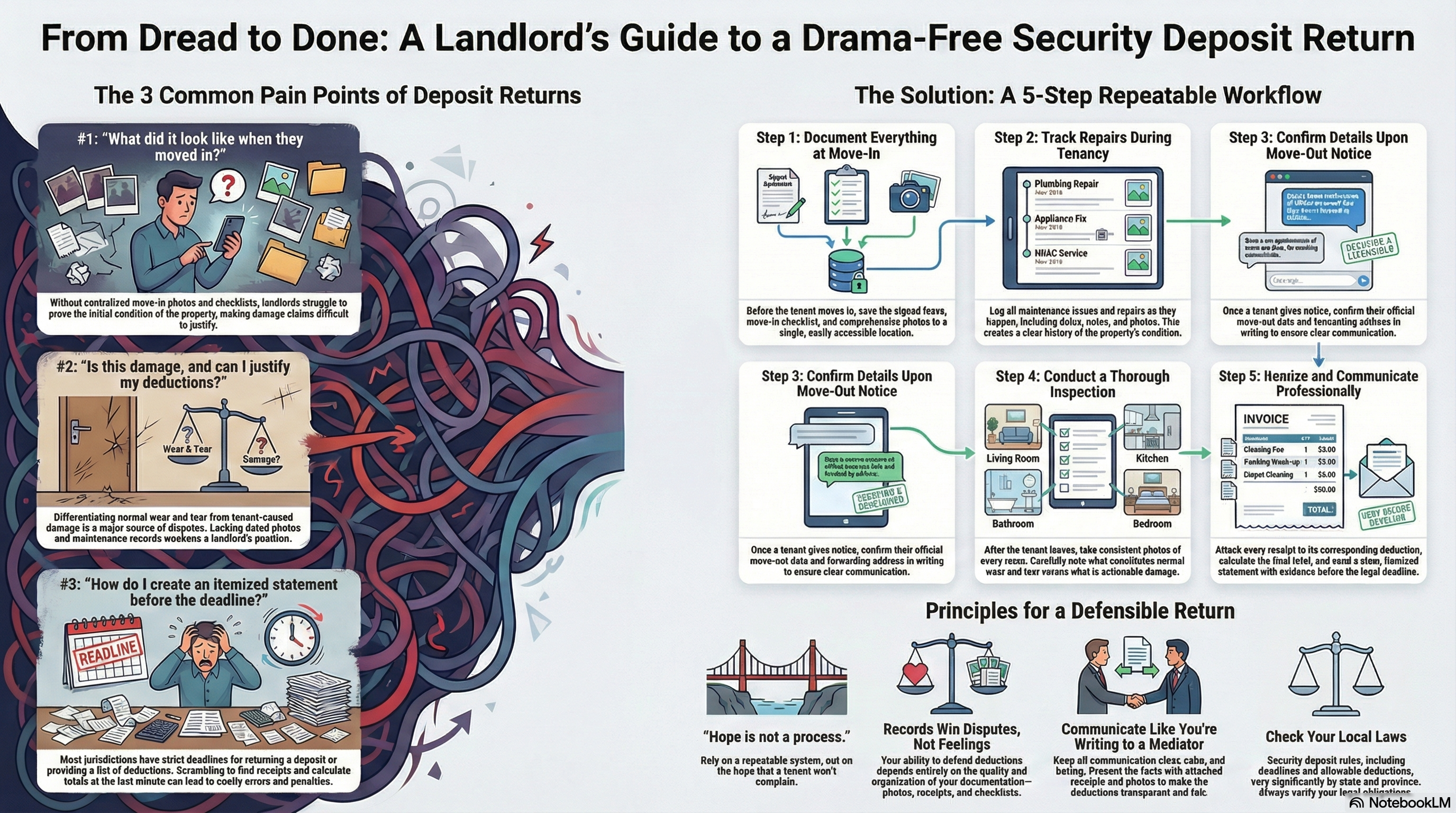
A simple security deposit return workflow you can copy
Sarah wrote her new process on a sticky note and slapped it onto her laptop:
Move-in: photos, checklist, and lease saved in one place.
During tenancy: log repairs as they happen with dates and notes.
Move-out notice: confirm forwarding address and move-out date in writing.
Inspection: take consistent photos, note wear vs damage.
Deductions: attach receipts, calculate totals, send itemized statement before the deadline.
It wasn’t fancy. It was just repeatable.
Near the end of the week, Sarah watched the e-transfer confirmation pop up. Deposit returned. File closed. No angry thread. No sinking dread.
She texted Marco.
“Deposit returned. No drama.”
He replied: “Teach me your ways.”
Sarah smiled (and finally drank a fresh coffee).
If you want your next security deposit return to feel this boring, set up your workflow inside RentMouse so your photos, leases, repairs, and expenses are ready before the next move-out.
CTA: Start your RentMouse setup now and build a move-out ready system that makes security deposit return faster, clearer, and easier to defend.
Sources
In the USA, security deposit rules vary by state. In Canada, rules vary by province. Always check your local law and tribunal guidance for deadlines, allowable deductions, and notice requirements.
[1] U.S. Department of Housing and Urban Development (HUD), Tenant Rights and Responsibilities (general housing guidance): https://www.hud.gov/topics/rental_assistance/tenantrights
[2] Ontario Landlord and Tenant Board, Brochures and Guides (deposits and charges guidance): https://tribunalsontario.ca/ltb/brochures/
[3] California Department of Consumer Affairs, Security Deposits Guide: https://www.dca.ca.gov/publications/landlordbook/cap08.shtml
[4] Government of British Columbia, Residential Tenancies (deposits, condition inspection reports): https://www2.gov.bc.ca/gov/content/housing-tenancy/residential-tenancies/starting-a-tenancy/deposits-fees
Test Your Knowledge! 🎯
Question 1 of 5


