
The first sign was the sound.
Not a drip. A hiss.
It was 6:38 a.m. in Minneapolis, still dark, the kind of cold that makes the air feel sharp in your nose. Alex, a small landlord with a triplex and a full-time job, stared at a tenant’s video: water pushing out from under a bathroom vanity like it had somewhere urgent to be.
Minnesota landlord law wasn’t something Alex read for fun. It was the thing he googled with one hand while pulling on boots with the other.
Background: a small landlord, a busy week, and one very loud problem
Alex had three units in a 1920s triplex. Solid place. Old pipes.
He’d been managing everything with a patchwork system: text threads, a spreadsheet called “RENT FINAL v7,” and a shoebox of receipts that smelled faintly like motor oil (don’t ask).
Then February hit.
Two things happened in the same 72-hour window:
A frozen pipe burst and soaked a vanity base.
The upstairs tenant paid rent five days late, again.
And a third thing was looming: a move-out at the end of the month, which meant the security deposit clock was about to start.
In Minnesota, landlords generally must return the security deposit (or provide an itemized statement of deductions) within 21 days after the tenancy ends and the tenant leaves. That countdown is real, and it doesn’t care that you’re tired.[1]
The challenge: 3 pain points that were quietly costing him money
Pain point #1: Maintenance requests were scattered, and “proof” was basically vibes
The tenant’s first message about the slow drain had been three weeks earlier. Alex remembered it. Sort of.
But remembering isn’t documentation.
Minnesota landlord law ties into habitability expectations and repair responsibilities, and disputes often turn on timelines and records: when the tenant reported it, when the landlord responded, what contractor said, what was fixed.[2]
Alex’s issue was simple: he was responding, but he couldn’t show it cleanly.
So he moved the repair workflow into RentMouse using the built-in maintenance tracking at /features/maintenance. One place. One timeline. Photos, notes, vendor invoices. The whole story, saved while it was happening.
The next morning, the plumber arrived. Wet drywall smell. Cold tile underfoot. The tenant stood in socks, arms crossed, looking like she hadn’t slept.
Alex logged:
Request time: 6:38 a.m.
Plumber booked: 7:12 a.m.
Arrival: 9:05 a.m.
Work completed: 10:47 a.m.
Photos: before and after
A tiny admin step. A massive stress drop.
Pain point #2: Late rent kept becoming a negotiation
The upstairs tenant wasn’t a bad person. Just… inconsistent.
Alex’s old process was a polite text, then another, then a weird silence where he’d refresh his banking app like that would help (it didn’t).
He needed rent to be boring.
So he turned on online payments and reminders through RentMouse, and routed the tenant to /features/rent-collection. The change was immediate: scheduled payments, automatic receipts, and a clear ledger that didn’t depend on Alex’s memory.
Alex also reviewed his lease terms to confirm how late fees and timing were written, then organized the signed lease and addenda in /features/lease-management so he wasn’t hunting PDFs at midnight.
Pain point #3: The security deposit deadline was coming, and his receipts were chaos
Move-out was set for the 31st. Alex knew the 21-day Minnesota security deposit return rule, but his usual method was… loose.
Loose means risky.
He’d done the classic thing: buy supplies at a hardware store, pay a cleaner, forget where the receipt went, then try to reconstruct it later. If there were deductions, he needed to back them up. If there weren’t, he needed to return the deposit fast.
He started tracking move-out costs and invoices in /features/expense-tracking so every deduction had a date, a vendor, and a receipt attached.
(He joked to a friend that he was “finally becoming a real adult.” The friend did not let that slide.)
The solution: a simple Minnesota landlord law workflow that held up under pressure
Alex didn’t “implement a system.” He just stopped letting the work live in ten places.
Here’s what changed over two weeks.
1) Repairs became a timeline, not a debate
Tenant request submitted.
Vendor assigned.
Updates posted.
Photos stored.
Invoice attached.
When the tenant asked, “Did you even call someone?” Alex didn’t argue. He sent the maintenance log. Calm. Factual. (His shoulders dropped when he hit send. That part surprised him.)
2) Rent collection became predictable
Alex switched that upstairs tenant to online payments. The tenant could pay by bank transfer and see receipts immediately.
No more:
“Did you get it?”
“I think it’s processing.”
“Can I pay you next Friday?”
Just a payment record that matched the lease terms.
3) The move-out process became deposit-deadline proof
Alex scheduled a move-out walkthrough, took date-stamped photos, and logged cleaning and repair costs as they happened.
Minnesota’s 21-day requirement meant he planned backward:
Day 0: tenant vacates
Day 1 to 3: inspection and estimates
Day 4 to 10: cleaning and minor repairs
Day 11 to 14: finalize deductions and paperwork
Day 15: mail deposit and itemization
He didn’t wait until day 20 with a sinking feeling and a messy desktop.
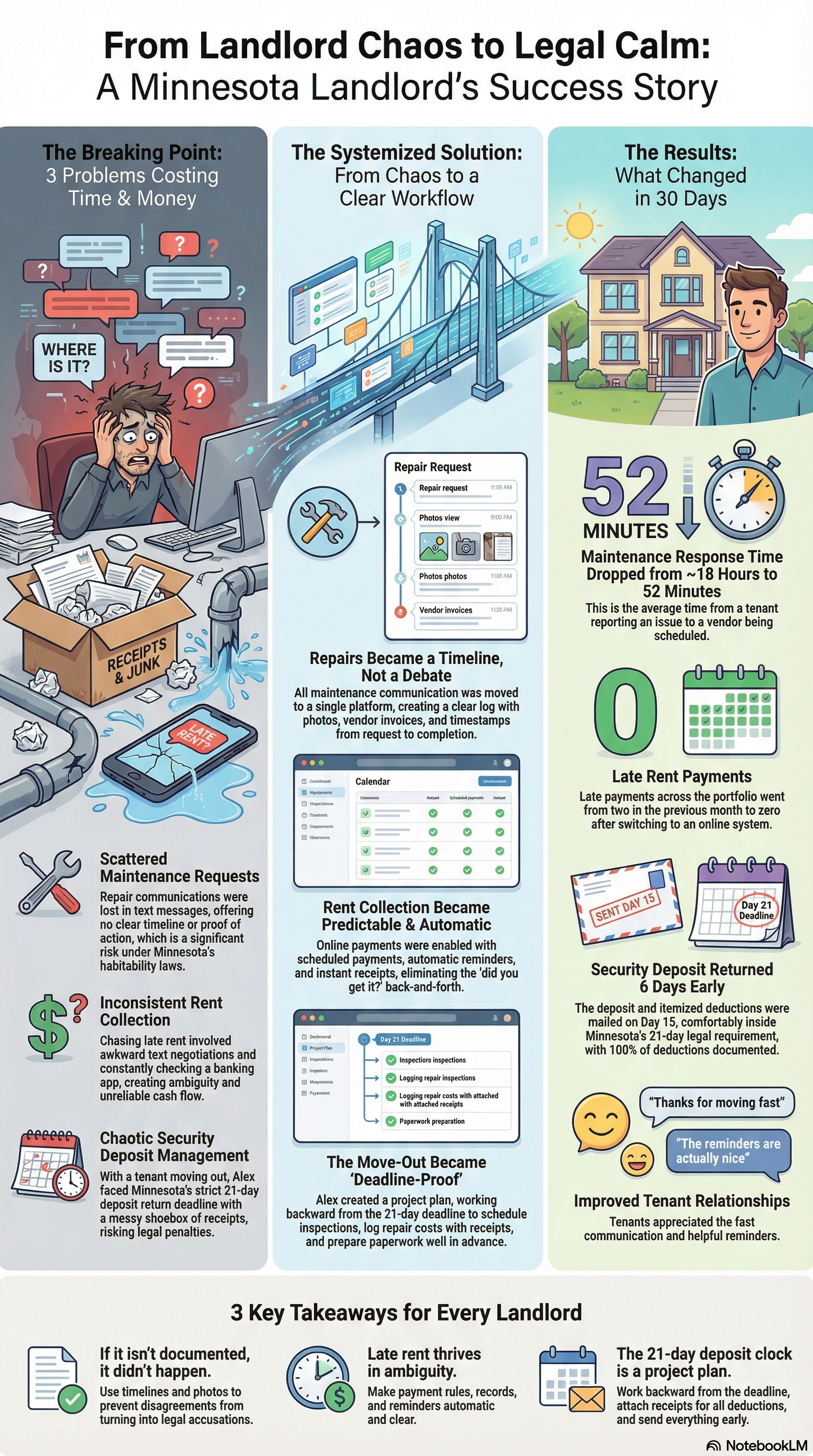
Results: what changed in 30 days (with numbers)
Alex tracked outcomes for the month after switching his workflow into RentMouse.
Maintenance response time improved
Average time from tenant report to vendor scheduled: from ~18 hours to 52 minutes
Time to resolution for the frozen pipe incident: same-day (4 hours, 9 minutes)
Late rent dropped
Late payments (portfolio-wide) went from 2 late payments in the prior month to 0 late payments the next month.
Alex estimated he saved 3.5 hours of back-and-forth texting and bank-checking.
Security deposit deadline was met early
Deposit return and itemization sent on Day 15, comfortably inside Minnesota’s 21-day requirement.[1]
Deductions documented with receipts: 100% attached (cleaning, vanity base materials, and one contractor trip fee)
The human result: fewer tense conversations
The tenant in the repaired unit texted two days later:
“Thanks for moving fast. I’ve had landlords who’d drag this out for weeks. The updates helped.”
And the upstairs tenant, the late payer, surprised Alex by saying:
“The reminders are actually nice. I don’t want to be the ‘late rent guy.’”
(That line made Alex laugh out loud in his car. Small wins count.)
What Minnesota landlord law taught Alex the hard way
Minnesota landlord law isn’t just statutes and summaries. It’s how your Tuesday goes when a pipe bursts and your tenant wants answers now.
Three takeaways Alex wrote on a sticky note and kept on his monitor:
If it isn’t documented, it didn’t happen. Timelines and photos prevent arguments from becoming accusations.
Late rent thrives in ambiguity. Make payment rules and records automatic.
The 21-day deposit clock is a project plan. Work backward, attach receipts, and send it early.
Minnesota landlord law compliance got easier when Alex stopped relying on memory and started relying on clean records.
CTA: Make your next emergency smaller
If you’re managing rentals in Minnesota (or anywhere in the U.S. or Canada) and your admin lives in texts and spreadsheets, set up RentMouse and run one clean workflow for rent, repairs, leases, and expenses.
Start here: see plans and start a trial at /pricing.
Sources
[1] Minnesota Revisor of Statutes, 504B.178 (Security deposit; interest; withholding; penalties). https://www.revisor.mn.gov/statutes/cite/504B.178
[2] Minnesota Attorney General, Landlords and Tenants: Rights and Responsibilities. https://www.ag.state.mn.us/consumer/handbooks/lt/default.asp
[3] U.S. Department of Housing and Urban Development (HUD), Housing Quality Standards (HQS) overview. https://www.hud.gov/program_offices/public_indian_housing/programs/hcv/hqs
[4] U.S. Census Bureau, American Housing Survey (AHS) data and reports. https://www.census.gov/programs-surveys/ahs.html
Test Your Knowledge! 🎯
Question 1 of 5


