
The hallway outside Unit 3B smelled like fresh paint and cold coffee.
Nina stood there with her phone in one hand and a ring of keys in the other, listening to the building settle. Little creaks. A distant elevator thunk. Chicago winter doing its thing.
She wasn’t trying to be difficult. She was trying to replace a leaking shutoff valve before it turned into a ceiling stain downstairs.
Then the text came in.
“Are you seriously trying to enter my apartment with no warning?”
Nina blinked. Hard.
Because she had warned him. Or at least she thought she did. A quick message yesterday afternoon. A voicemail. Something. Now she was replaying the last 24 hours like a bad highlight reel (you know the one).
And that’s how an ordinary repair turns into a question every Illinois landlord eventually asks:
Illinois landlord right of entry notice. How much notice do you need?
Illinois landlord right of entry notice: the moment it stops being “a policy”
Nina owned a small three-flat. She worked a day job. Landlording happened in the gaps between meetings, errands, and whatever was burning in the oven.
Unit 3B was occupied by Marco, a night-shift nurse who slept during the day and guarded his quiet like it was a life raft.
The leak wasn’t dramatic. Not yet.
A slow drip under the kitchen sink. A little metallic smell. A damp cabinet floor that felt cool and slightly spongy when Nina pressed it with her thumb.
Marco had reported it, but he’d added a line that made Nina pause:
“Please don’t just show up. I had a landlord do that before.”
Nina’s stomach tightened. She’d heard the stories.
Still, she needed access.
Here’s the tension: Illinois landlord right of entry notice is partly about law and partly about trust. If either one breaks, the whole week gets longer.
Pain point #1: “I texted you” is not the same as a clean entry notice
Nina scrolled through her messages. There it was. A text sent at 4:58 p.m.
“Plumber can come tomorrow morning.”
No time window. No reason stated. No “please confirm.” No paper trail beyond a single vague sentence.
Marco replied at 2:11 a.m.
“I’m asleep in the morning. No.”
Now Nina had a leak, a refusal, and a growing fear that she was about to step on a legal rake.
In Illinois, statewide statute doesn’t spell out one simple number of hours that applies everywhere for routine entry. Many landlords follow a reasonable notice standard and rely on what the lease says, while local rules can be stricter, especially in larger cities. For example, Chicago’s Residential Landlord and Tenant Ordinance (RLTO) includes a two-day notice expectation for non-emergency entry in many situations.[1]
That was Nina’s first mistake: treating “notice” like a casual heads-up instead of a documented step.
So she rewrote her approach. Not a longer argument. A better process.
She opened RentMouse and pulled up her lease details in lease management so she could confirm what her own contract said about access, notice, and entry windows. (Yes, she’d read it before. No, she didn’t remember it at 7:12 a.m.)
Then she drafted a clear entry message:
Reason for entry: kitchen sink leak repair
Proposed date and time window
Request for confirmation or alternate times
Note about emergency access if the leak worsened
She sent it and saved it to the tenant record.
Marco responded ten minutes later.
“You’re saying 1 to 3 p.m.? That works. Please knock first.”
Nina exhaled so hard she felt it in her shoulders.
Three words. Huge relief.
Pain point #2: Maintenance access turns into a scheduling and proof problem
The plumber arrived with wet boots and a canvas tool bag that clinked when he set it down.
“Where’s the leak?” he asked.
Nina led him in, careful to keep the visit tight. Fix the valve. Check for damage. Leave.
But halfway through, the plumber frowned.
“This cabinet’s been wet awhile. Might be a slow supply line leak too. I need to come back with parts.”
Nina’s brain did the math.
Second entry.
Second notice.
Second chance for a misunderstanding.
And she could already imagine Marco’s face if she got it wrong.
This is where landlords get stuck: you’re not only managing the repair, you’re managing the access narrative. Who asked. When. What was agreed. What changed.
Nina logged the issue as a formal request in maintenance tracking inside RentMouse, attaching the plumber’s note and the photos of the damp cabinet floor.
That did two things at once:
It gave her a timeline she could point to if the conversation got weird.
It made the next entry notice easy to send with specifics, not vibes.
Marco texted again later.
“Can you do it after 4? I’m on nights.”
Nina replied:
“Yep. I’ll schedule 4:30 to 6:30 and send the notice here too.”
He wrote back:
“Thanks for being clear.”
It was such a small line. It felt enormous.
(Also, she didn’t have to chase him across three apps and a sticky note. Bless.)
Pain point #3: The “showing request” that lights the fuse
Two weeks later, Nina got an email from a prospective tenant for Unit 1A. Great.
But the email ended with:
“Can I also see 3B? I love the layout.”
Nina stared at the screen.
Showing an occupied unit is where entry fights are born. Tenants feel ambushed. Landlords feel blocked. Everyone feels disrespected.
And Illinois is not a one-size-fits-all state for this.
Many landlords use a “reasonable notice” standard for non-emergency entry.
Some cities add specific requirements. Chicago’s RLTO is the big one people cite for notice expectations and tenant protections.[1]
Nina didn’t want to guess. She wanted a repeatable workflow.
So she did two things:
First, she checked her lease clause again in RentMouse.
Second, she stored her city specific reference material and templates in document storage so she could reuse the same showing notice format every time: purpose, date, window, and a clear ask for confirmation.
Then she offered Marco options.
“Hey Marco, I have a showing request. Would tomorrow 5 to 6 p.m. work, or Saturday 2 to 3? If neither, tell me what does.”
He replied:
“Saturday is better. I’ll tidy up.”
Nina laughed quietly in her kitchen.
Because that’s what clarity does. It turns resistance into cooperation.
What “reasonable notice” means in real life (and why Illinois can feel confusing)
Nina’s friend, also a landlord, tried to simplify it for her over a crackly phone call.
“Just give 24 hours,” he said.
Nina didn’t love that answer.
Not because it’s always wrong, but because it’s not always right.
In Illinois, entry rules can come from:
Your lease language
Local ordinances (Chicago is the common example)[1]
General expectations around reasonableness and privacy
Emergency exceptions (like active leaks, fire, or situations where waiting would cause damage)
And if you’re screening tenants or handling disputes, documentation matters. If things escalate, you want to show consistent, professional behavior, not a chaotic thread of “I think I texted you?”
That’s why Nina built a simple system.
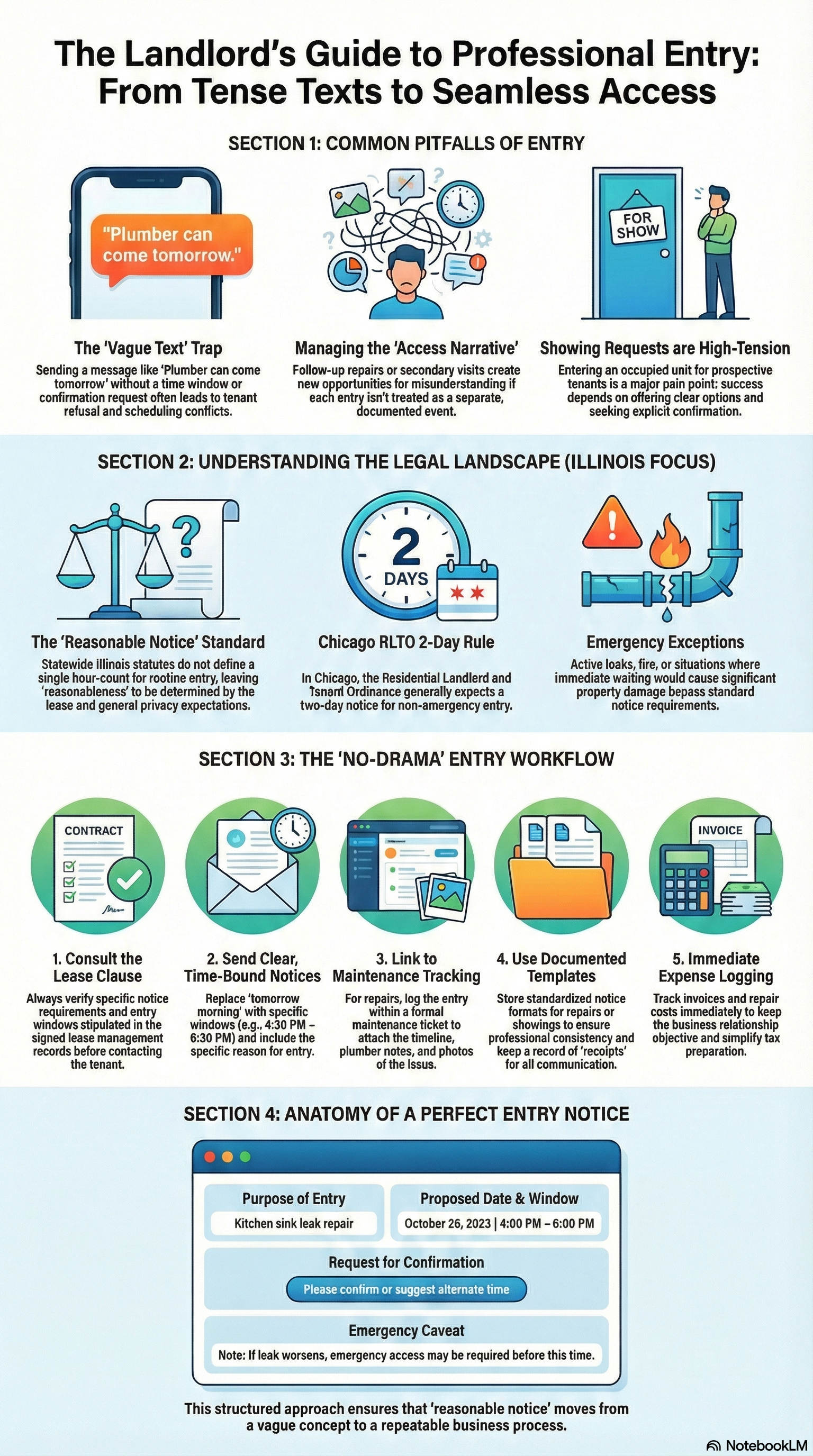
The workflow Nina ended up using (and kept using)
She called it her “no-drama entry routine.” It wasn’t fancy. It was reliable.
Check the lease clause first
She used lease management to confirm what her lease required before she sent anything.
Send one clear notice with a time window
Not “tomorrow morning.” A real window.
Tie entry to a maintenance ticket
For repairs, she logged it under maintenance tracking so the reason and timeline were always attached.
Store templates and proof
She kept her notice templates, photos, and vendor notes in document storage.
If money was involved, track it immediately
Because the leak repair had a cost, she logged the invoice in expense tracking so tax time wouldn’t feel like punishment.
That last step surprised her. It changed her mood.
When the numbers were organized, she stopped resenting the repair.
It was just part of the business again.
Illinois landlord right of entry notice near the finish line: the text that proved it worked
A month later, Marco sent a message that could’ve gone sideways.
“Hey. My neighbor said you were in the hallway with a contractor. Are you coming in today?”
Old Nina would’ve panicked.
New Nina opened RentMouse, checked the timeline, and replied with calm receipts.
“No entry today. Next scheduled entry is Thursday 4:30 to 6:30 for the supply line follow-up, per the notice we agreed on. I’ll knock first.”
Marco replied:
“Perfect. Thanks.”
Nina set her phone down and listened to the radiator hiss.
Quiet. Normal. The good kind.
And that’s the real win with Illinois landlord right of entry notice: it’s not about “getting in.” It’s about staying professional, staying documented, and keeping the relationship intact while the property stays maintained.
RentMouse didn’t make Illinois simpler. It made Nina’s workflow sturdier.
(And honestly, she slept better. That counts.)
CTA: Make entry notices boring again
If you’re tired of entry requests turning into tense texts, start a cleaner workflow today. Try RentMouse to keep leases, notices, maintenance access, and records in one place.
Start your trial and run your next Illinois landlord right of entry notice the calm way.
Sources
[1] Chicago Department of Housing, Chicago Residential Landlord and Tenant Ordinance (RLTO) summary and resources. [2] Illinois General Assembly, Illinois Compiled Statutes (Illinois statutory law portal). [3] U.S. Department of Housing and Urban Development (HUD), Tenant Rights and Responsibilities resources. [4] Government of Canada, Office of Consumer Affairs, Renting a home (general tenant and landlord information).
Test Your Knowledge! 🎯
Question 1 of 5


