
Move-In Inspection Checklist (With Photos): The Landlord System That Prevents Deposit Disputes
The key smelled like pennies.
Maya stood in the hallway outside Unit 4C, thumb rubbing the worn metal while the building’s old radiator clicked like it was counting down. Fresh paint still carried that sharp, sweet bite in the air, but underneath it was the faint scent of someone else’s detergent. A new tenancy. A new start.
And a familiar worry.
Because the last time Maya skipped a proper move-in inspection checklist, she paid for it. Not in cash, at first. In time. In late-night scrolling through blurry photos. In that sinking feeling when a tenant says, “That scratch was already there.”
Today, she promised herself, would be different.
The move-in inspection checklist moment that decides your whole tenancy
Her new tenant, Jordan, arrived with a small tower of boxes and a winter jacket still damp from the sidewalk slush. He looked excited. Maya looked calm on the outside.
Inside her head: loud.
“Before we do keys,” Maya said, forcing her voice to stay light, “let’s do a quick walk-through and document everything. It protects both of us.”
Jordan paused. “Like… you think I’m going to wreck the place?”
“No,” Maya said, quick. “Like I don’t want us arguing later about what was already here.” (Because nobody wins that fight.)
That was pain point number one.
Pain point #1: The security deposit dispute that starts on day one
Most deposit blowups aren’t about a single scuff. They’re about missing baseline proof.
Maya had learned that the hard way after a move-out where she had:
photos, but not enough
notes, but not consistent
receipts, but scattered
And when the tenant pushed back, she didn’t have one clean, shareable record.
So she built a system that made the move-in inspection checklist boring. Repeatable. Provable.
She opened RentMouse and pulled up her lease packet, then the shared folder where she keeps condition reports and photos. Everything in one place, not sprinkled across texts and camera rolls. She’d already stored the signed lease and addenda using document storage.
“Okay,” she said, “we’ll go room by room. I’ll take photos. You’ll confirm anything you want noted. Then we both keep a copy.”
Jordan nodded, shoulders dropping a little. “Honestly… that’s fair.”
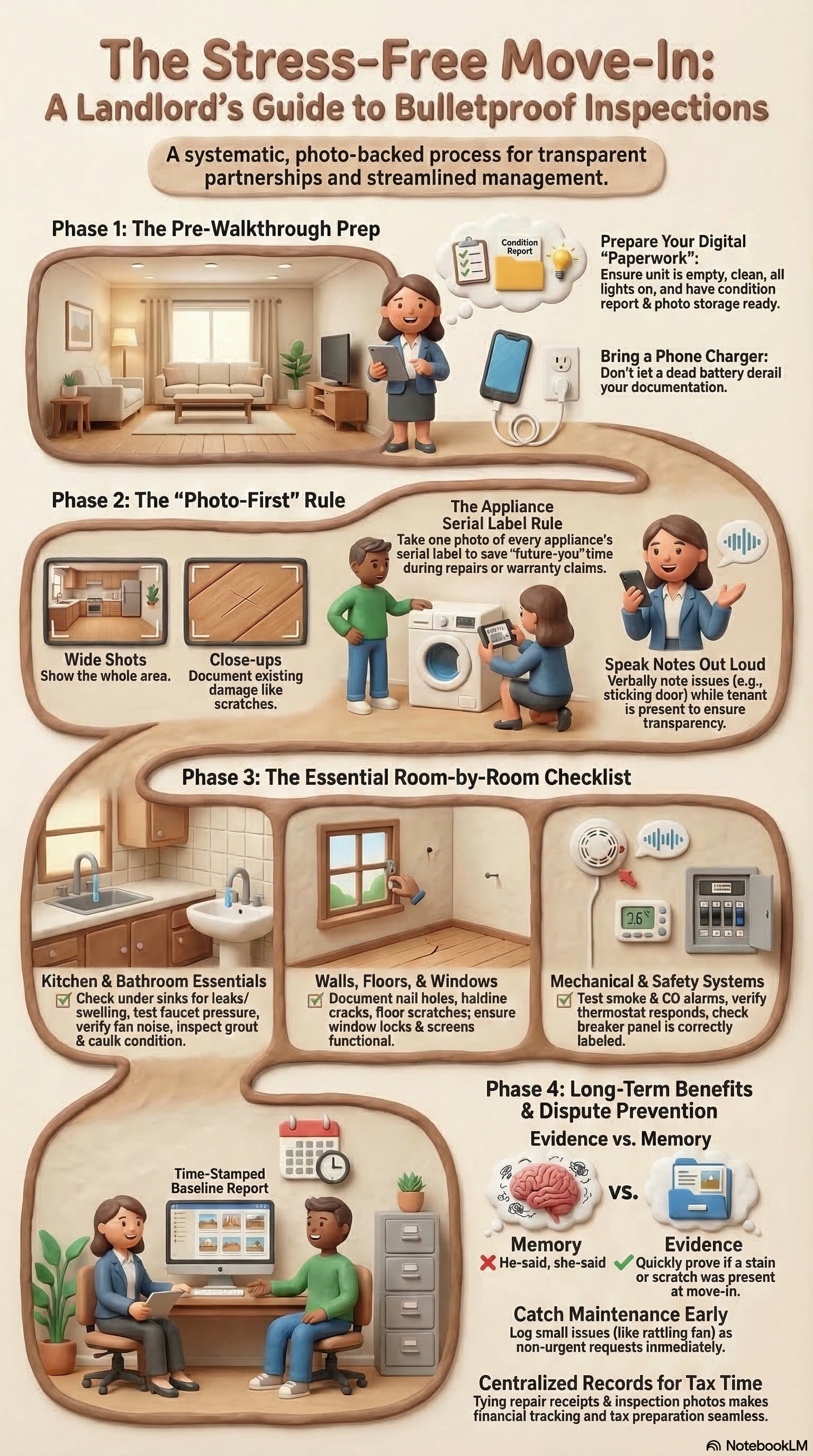
The move-in inspection checklist: the photo-first walkthrough Maya used
They started at the entry.
The floor was cool underfoot. The overhead light buzzed faintly. Maya snapped a wide-angle photo, then a closer shot of the baseboards.
Her rule was simple:
Wide shot to show the whole area
Close-up for any existing damage
One photo per appliance serial label (future-you will say thank you)
And she spoke her notes out loud so Jordan could hear them.
“Small paint nick by the closet hinge,” she said.
Jordan leaned in. “Can you also note the door sticks a bit?”
“Absolutely.”
Three words. Big difference.
What to photograph (6 areas landlords forget)
Maya used the same checklist every time:
Floors and baseboards: scratches, gaps, stains, transitions
Walls and ceilings: nail holes, hairline cracks, water marks
Windows and screens: locks, chips, broken seals, torn mesh
Kitchen: inside cabinets, under sink, backsplash, appliance faces
Bathroom: grout lines, caulk edges, fan operation, under vanity
Mechanical and safety: smoke and CO alarms, thermostat, breaker panel label
She didn’t try to be dramatic.
She tried to be clear.
(Also, she took photos of the empty fridge. It felt silly. It wasn’t.)
When maintenance becomes a “he said, she said” problem
Halfway through the walkthrough, Jordan flicked the bathroom fan switch. The fan groaned, then settled into a tired rattle.
Jordan raised an eyebrow. “Is it supposed to sound like that?”
Maya felt the familiar pinch in her stomach. If she ignored it, it would become a move-out argument later. If she fixed it, it was another task on an already packed week.
Pain point number two.
Pain point #2: Small issues that turn into big conflicts
A move-in inspection checklist isn’t only about deposits. It’s about catching early maintenance issues before they become:
“You never fixed this.”
“I told you months ago.”
“That mold wasn’t my fault.”
Maya logged the fan as a non-urgent maintenance item right then, while they were standing in the bathroom, the air smelling faintly like new shower curtain plastic. She created the request and added the photo and note so it was tied to the unit history using maintenance tracking.
Jordan watched her do it.
“So it’s in the system now?” he asked.
“Yep,” Maya said. “And you’ll see updates. No guessing.”
That transparency did something subtle.
It softened the room.
The lease detail that prevents the first awkward text
Back in the kitchen, Maya opened the cabinet under the sink. Clean. Dry. A faint smell of pine cleaner.
Then she pointed to a line in the lease: how to report repairs, what counts as an emergency, and how entry notices work.
Pain point number three.
Pain point #3: Unclear expectations that explode at 11:47 p.m.
Landlords lose nights to vague processes. Tenants lose patience to silence.
Maya used RentMouse to keep the lease and rules organized and easy to reference, so she wasn’t hunting through email threads later. Her lease workflow lived in lease management.
Jordan laughed once, short. “So I shouldn’t text you a blurry photo of a drip at midnight?”
Maya smiled. “Only if it’s actually dripping.” (Please don’t make it drip.)
The checklist itself: a simple template you can copy
Here’s the move-in inspection checklist Maya followed, written the way she’d want to read it on a busy day.
1) Before the walkthrough (10 minutes)
Confirm unit is empty and clean
Turn on all lights
Bring a phone charger (your battery will betray you)
Prepare a condition report document and a place to store photos
2) Entry and common areas
Door and locks: smooth open/close, deadbolt works
Floors: scratches, stains, loose boards
Walls: marks, holes, patch jobs
Smoke and CO alarms: present and functional
3) Kitchen
Faucet: hot and cold, water pressure
Under sink: leaks, cabinet swelling
Appliances: photo of each appliance and serial label
Cabinets and drawers: open/close, damage inside
4) Bathroom
Toilet: flush, base stable, no rocking
Tub and shower: caulk condition, water pressure
Fan: works, noise level noted
Under vanity: leaks, mildew smell
5) Bedrooms
Windows: locks, screens, drafts
Closets: doors track correctly
Flooring and baseboards: corners and under windows
6) Mechanical and exterior (if applicable)
Thermostat: responds
Heater and AC: basic function check
Water heater: photo label, visible leaks
Balcony or patio: railing stable, surface condition
7) Sign-off and sharing
Summarize existing issues in plain language
Attach key photos to the condition report
Share the final copy with the tenant
Maya didn’t aim for perfection.
She aimed for evidence.
The money part nobody wants to do during move-in
As they wrapped up, Jordan asked the question tenants always ask when they’re trying to be responsible.
“How do you want rent paid?”
Maya used to accept whatever came in: checks, e-Transfers with strange notes, partial payments that required detective work.
It made her bookkeeping feel like wet paper.
Now she kept it simple, consistent, and trackable using rent collection.
Jordan nodded again. “So I’ll get a receipt?”
“Automatically,” Maya said. “And I can see what’s paid, what’s pending, and what’s late.”
That was the point.
Less fog.
The quiet benefit: your inspection photos become your maintenance and cost history
Two weeks later, the bathroom fan was replaced. The contractor’s invoice hit Maya’s inbox while she was standing in line for coffee, the smell of espresso and warm pastry making the day feel almost normal.
In the past, that invoice would’ve vanished into a folder called “Receipts 2026 FINAL FINAL.”
Instead, she saved it to the unit’s record and categorized it, so tax time wouldn’t feel like a punishment. RentMouse made it easy to connect repairs to the property’s financial story using expense tracking.
Jordan sent a message later that day.
“Fan’s quiet now. Thanks for fixing it so fast.”
Maya read it once.
Then again.
Because it’s rare to feel ahead.
How this prevents deposit disputes later (the part that matters)
Months from now, when move-out happens, Maya won’t be relying on memory or a handful of random photos.
She’ll have:
a time-stamped baseline condition report
room-by-room photos from move-in
a log of maintenance issues that existed at move-in
receipts tied to the unit and repair
That’s what keeps a security deposit conversation calm.
And when she thinks about it, the whole thing started with a move-in inspection checklist and the decision to treat documentation like part of the rental, not an optional chore.
RentMouse didn’t make her a different person.
It just made her process easier to repeat.
Near the finish line: the text that didn’t turn into a fight
Three months in, Jordan texted:
“Hey, I noticed a small stain near the baseboard in the bedroom. Was that there before?”
Maya didn’t feel panic.
She opened the move-in photos. Wide shot. Close-up. Baseboard corner.
She replied:
“Good catch. It wasn’t there at move-in. Please submit it as a maintenance request so we can check for a leak.”
Jordan answered:
“Done.”
No drama.
No accusations.
Just a problem getting handled.
CTA: Make your next move-in boring (in the best way)
If you want your next move-in inspection checklist to be simple, photo-backed, and easy to share, set up your workflow in RentMouse and keep everything tied to the unit from day one.
Start with RentMouse, run your next move-in walkthrough, and keep the proof where you can actually find it.
Sources
Move-in inspections and deposit rules vary by state and province. The references below provide general guidance on security deposits, rental housing context, and tenant rights frameworks.
U.S. Department of Housing and Urban Development (HUD), "Tenant Rights and Responsibilities" and rental housing resources. [1]
Consumer Financial Protection Bureau (CFPB), "Renting a home" consumer guidance. [2]
Government of Ontario, Residential Tenancies Act information and guidance (security deposits and landlord-tenant rules). [3]
Government of British Columbia, Residential Tenancy Branch (condition inspection reports and deposits). [4]
Statistics Canada, housing and rental market indicators (context for rental demand and mobility). [5]
Test Your Knowledge! 🎯
Question 1 of 5


